
AI opportunities are everywhere.
Every business function can point to processes that take too long, decisions that depend on incomplete information, and repetitive work that consumes employee time. AI appears capable of improving many of them.
That abundance creates a new problem. When almost every process looks like a possible AI use case, deciding where to begin becomes difficult.
Business teams submit ideas. Technology teams test new tools. Vendors demonstrate impressive capabilities. Leaders approve pilots to maintain momentum. Before long, the organization has a long list of AI possibilities but no clear view of which ones deserve investment.
The important question is not whether AI could be used.
It is whether AI should be used for this particular problem.
Which AI use cases can create meaningful and measurable business value?
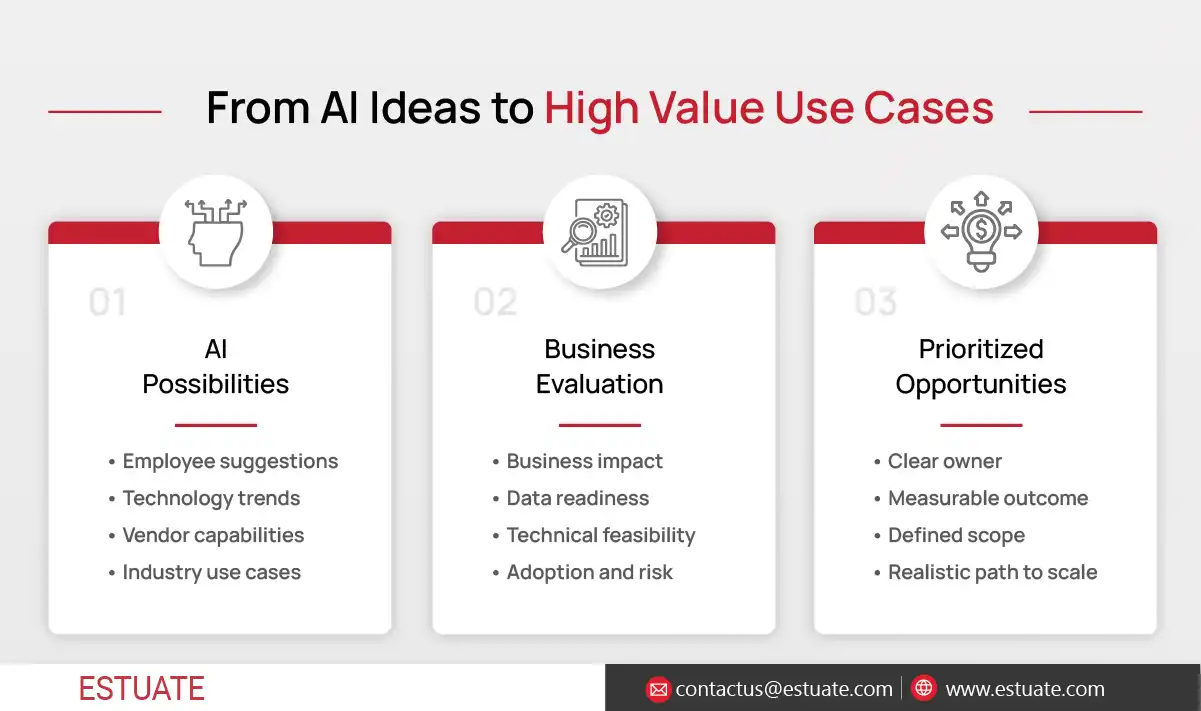
High-value use cases sit at the intersection of business impact, data readiness, technical feasibility, user adoption, and manageable risk. If one of these elements is missing, even an impressive AI solution can struggle to move beyond a pilot.
This is why use-case selection cannot be treated as a brainstorming exercise. It needs a structured business evaluation.
“The best AI use case is not the most advanced idea. It is the right problem, supported by the right data, with a result the business can measure.”
Why AI Use Case Selection Matters
Enterprise AI programs rarely suffer from a shortage of ideas. They suffer from too many ideas competing for limited time, funding, data, and technical capacity.
Without a clear prioritization method, organizations often select projects based on visibility or novelty. A senior leader proposes an idea. A competitor announces a new capability. A software vendor launches an AI feature. A team builds a pilot because the technology is available.
These signals may justify exploration, but they do not prove business value.
A use case can be technically possible and still be a poor investment. It may solve a low-priority problem, depend on unreliable data, require extensive integration, create unacceptable risk, or deliver benefits that cannot be measured.
Meanwhile, less glamorous opportunities may offer stronger returns. Improving document review, accelerating customer support, reducing billing errors, detecting data-quality issues, or helping employees find trusted information may create value faster than a highly ambitious transformation project.
“A long list of AI ideas is not an AI roadmap. Prioritization turns possibilities into investable opportunities.”
What Makes an AI Use Case High Value
A high-value AI use case does more than demonstrate what the technology can do. It improves an outcome that matters to the business and can be implemented within the organization’s operating reality.
The following factors help separate promising opportunities from expensive distractions.
It Solves a Clear Business Problem
Strong AI use cases begin with a defined problem, not a preferred technology. The business should be able to explain what is not working today, who is affected, and why the issue deserves attention.
For example, ‘use generative AI in customer service’ is not a clear use case. ‘Reduce the time support agents spend searching multiple systems for accurate product information’ is much stronger. It defines the user, the workflow, and the problem that needs to improve.
Before considering a solution, ask:
- What specific business problem are we trying to solve?
- How is the problem handled today?
- How often does it occur?
- What does the current process cost in time, money, risk, or lost opportunity?
- Who owns the outcome?
If the problem cannot be described clearly without mentioning AI, the use case is not ready for investment.
It Creates Meaningful Business Impact
Not every improvement is valuable enough to justify an AI initiative. The expected outcome must matter at the scale of the organization.
Business value can take different forms. AI may reduce operating costs, shorten cycle times, improve customer experience, increase revenue, strengthen compliance, reduce risk, or help employees make better decisions.
Business value can take different forms. AI may reduce operating costs, shorten cycle times, improve customer experience, increase revenue, strengthen compliance, reduce risk, or help employees make better decisions.
Useful measures may include:
- Hours of manual effort reduced
- Processing or response time improved
- Errors, rework, or exceptions reduced
- Revenue conversion or retention increased
- Compliance coverage or audit readiness improved
- Employee or customer satisfaction improved
A use case with a measurable baseline creates a much stronger investment case than one supported only by broad claims about productivity.
AI Is the Right Method for the Problem
Some business problems do not need AI.
A rules-based workflow, system configuration change, dashboard, search improvement, or conventional automation may solve the problem more reliably and at a lower cost.
AI becomes useful when the work involves unstructured information, complex patterns, language, judgment support, prediction, recommendation, or variation that is difficult to manage through fixed rules alone.
AI may be a strong fit when the process requires:
- Understanding or generating natural language
- Extracting information from large volumes of documents
- Recognizing patterns across complex datasets
- Recommending actions based on context
- Supporting decisions where inputs vary significantly
- Coordinating multiple steps across a workflow
Choosing AI when simpler technology would work creates unnecessary cost and complexity. Good prioritization includes the discipline to reject weak AI ideas.
It Fits Into an Existing Business Workflow
An AI solution creates value only when people use it as part of their work. A standalone tool that requires employees to leave their core system, copy information manually, and change established processes may struggle to gain adoption.
The strongest use cases fit naturally into the workflow. They provide guidance at the right moment, automate a clearly defined step, or reduce effort without adding a new layer of complexity.
Organizations should consider:
- Where the AI capability will appear in the workflow
- Which systems it must connect with
- What action the user takes after receiving an output
- When human review or approval is required
- How employees will be trained and supported
If the operating model is unclear, the organization may build a useful capability that never becomes part of everyday work.
A Practical Framework for Prioritizing AI Use Cases
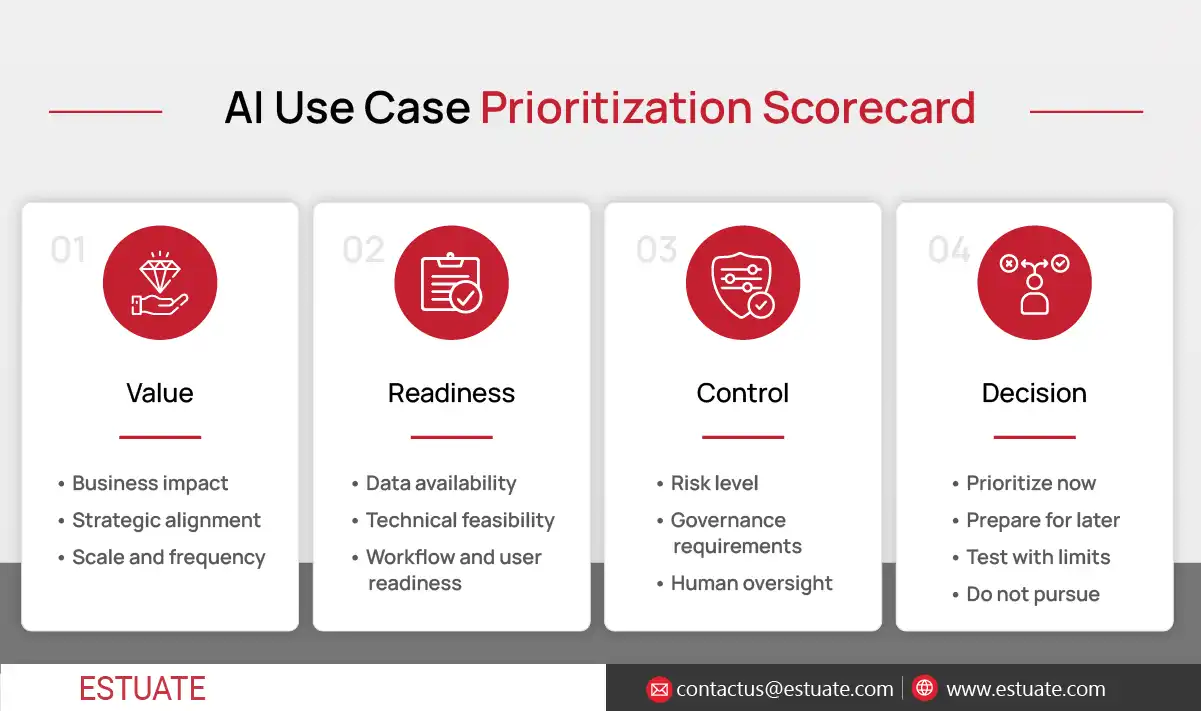
Once potential use cases have been defined, organizations need a consistent way to compare them. A simple scoring framework can make priorities more objective and reduce the influence of enthusiasm, hierarchy, or vendor pressure.
Each use case can be evaluated across six dimensions.
1. Business Value
How strongly does the opportunity support a strategic priority? Estimate its potential impact on cost, revenue, speed, experience, quality, or risk. Give higher scores to outcomes that matter at enterprise scale.
2. Problem Frequency and Scale
How often does the problem occur, and how many customers, employees, transactions, or decisions does it affect? A moderate improvement applied to a high-volume process can create significant value.
3. Data Readiness
Is the required data available, accessible, accurate, and approved for use? Consider both the quality of the data and the work required to connect it to the solution.
4. Technical Feasibility
Can the organization achieve the required level of accuracy, reliability, integration, security, and performance with available technology and skills?
5. Adoption Readiness
Will users trust and adopt the solution? Is there a clear process owner? Does the capability fit into the existing workflow, and is leadership prepared to support the required change?
6. Risk and Governance
What are the legal, regulatory, privacy, security, ethical, and operational risks? Can those risks be reduced to an acceptable level through controls and human oversight?
The highest-priority opportunities are usually those with strong business value and reasonable implementation readiness. High-impact ideas with low readiness should not automatically be rejected. They may become strategic initiatives that require data, process, or governance preparation before development begins.
Where Enterprises Should Look for AI Opportunities
The best use cases often appear in processes where business friction is already visible. Rather than asking teams to imagine futuristic applications, organizations can begin by looking for recurring patterns in everyday work.
High Volume Repetitive Work
Processes that involve reviewing, classifying, entering, reconciling, or summarizing large volumes of information may offer clear productivity gains. Examples include invoice review, document intake, support-ticket routing, report preparation, and data-quality checks.
Document and Knowledge Intensive Work
Employees often spend significant time searching policies, contracts, technical documents, project history, and customer information. AI can help retrieve, compare, summarize, and explain trusted information while linking responses to approved sources.
Slow or Inconsistent Decisions
Processes that rely on manual analysis or vary significantly between employees may benefit from AI-supported recommendations. The goal should be to improve consistency and speed while preserving accountability for the final decision.
Frequent Exceptions and Bottlenecks
AI can help identify anomalies, predict issues, recommend next actions, and route complex cases. Opportunities may exist in order management, billing, supply chain, compliance, maintenance, and customer operations.
Workflows Spread Across Multiple Systems
Employees often collect information from several applications before completing a task. AI assistants and agents may help coordinate these steps, but only when system access, permissions, controls, and exception handling are clearly designed.
Customer and Employee Experience Gaps
Repeated questions, delayed responses, difficult searches, and complex internal processes often reveal opportunities for AI. The strongest solutions improve the experience while maintaining accuracy and an easy path to human support.
Common Mistakes When Selecting AI Use Cases
Starting With the Technology
When organizations begin by asking where they can use a particular model or platform, they risk forcing technology into problems it was not chosen to solve. Start with the business need, then determine the right technical approach.
Choosing the Most Visible Idea
Executive interest can create momentum, but visibility should not replace evaluation. Every use case should pass through the same business, data, feasibility, adoption, and risk criteria.
Trying to Transform an Entire Function at Once
Large transformation ideas often contain several smaller use cases with different requirements and risks. Breaking the opportunity into focused workflows makes it easier to test value, learn, and scale.
Ignoring the Current Baseline
If the organization does not measure the existing process, it cannot prove that AI improved it. Baselines for time, cost, quality, volume, and experience should be established before implementation.
Treating Adoption as a Post Launch Activity
Employees need to understand how the solution supports their work, when to trust it, and when to challenge or escalate an output. Users and process owners should be involved before the solution is built.
Launching Too Many Pilots
A large pilot portfolio can create the appearance of progress while spreading resources too thinly. A smaller number of well-selected use cases is more likely to reach production and demonstrate value.
“Enterprise AI creates more value when organizations fund fewer, better-defined use cases and take them all the way to measurable outcomes.”
Turning Priorities Into Action
A high score does not mean a use case is ready for a full implementation. It means the opportunity deserves focused validation.
Begin with a small number of top-ranked use cases. For each one, confirm the process owner, current performance baseline, intended users, required information, expected outcome, and the assumptions that still need to be tested.
The next step should produce evidence, not another open-ended pilot:
- Define the exact workflow and user group
- Set one or two measurable success criteria
- Test the riskiest assumption first
- Decide in advance what would justify scaling, revising, or stopping
This keeps investment tied to business evidence and prevents weak ideas from continuing simply because time and money have already been spent.
Ready to Prioritize Your Enterprise AI Opportunities?
Whether your organization is exploring its first AI use cases or reviewing a growing portfolio of pilots, Estuate’s AI Advisory team can help assess opportunities, evaluate readiness, prioritize investments, and build a practical roadmap.
Contact us to identify the AI use cases with the strongest potential to deliver measurable business value.


