Traditional vs. Generative AI: Navigating the Future of Intelligent Enterprises
Artificial intelligence (AI) is rapidly transforming how businesses operate, with two major technologies leading the charge: Traditional AI and Generative AI. These technologies, each with their unique approaches, empower companies to navigate complex landscapes with remarkable agility and innovation.
Traditional AI, with its focus on structured data and rule-based systems, excels in tasks requiring precision and consistency. It’s like having a highly skilled craftsman on your team, ready to tackle data classification, anomaly detection, and predictive analysis with exceptional accuracy. This reliability makes Traditional AI indispensable in fields like finance, where it can detect fraudulent transactions, and healthcare, where it assists in diagnosing diseases from medical images. The transparency of its decision-making processes also ensures compliance and builds trust.
On the other hand, Generative AI operates like a creative visionary. By learning from vast datasets, it can generate new content and ideas, making it invaluable for content creation, financial scenario modeling, and business intelligence. Generative AI’s ability to handle uncertainty and produce novel outputs positions it as a transformative force in dynamic and fast-paced industries. Imagine having an AI that can draft complex legal documents, generate marketing materials, or create unique artistic works—significantly enhancing productivity and innovation.
With Traditional AI and Generative AI leading the way, businesses are experiencing a transformative shift in operations and strategy.
By leveraging the distinct strengths of both Traditional and Generative AI, businesses can optimize operations and drive strategic decision-making. Traditional AI brings robust, rule-based accuracy and efficiency, while Generative AI introduces creativity and adaptability. This powerful combination addresses specific business needs and positions companies to thrive in an increasingly competitive and rapidly evolving market.
Traditional AI: The Expert Specialist
Dive into the world of Traditional AI, where efficiency and precision reign supreme. Discover how it excels in specific tasks like classification and anomaly detection, making it a go-to for structured environments. Learn about its various applications across industries, and explore the benefits such as high accuracy and transparency in decision-making. However, we’ll also touch on the challenges, including its limited scope, the expertise required for development, and its lack of creativity. Whether you’re in finance, healthcare, or retail, understanding Traditional AI can help you leverage its strengths and navigate its limitations.
Core Applications of Traditional AI
Generative AI has a wide range of applications across various industries, showcasing its versatility and innovative potential. Here are some key areas where Generative AI excels:
Classification and Clustering
Traditional AI excels at categorizing and grouping data. For example, in the banking sector, it classifies transactions to detect fraud, while in healthcare, it assists in diagnosing medical images. This ability to sort vast amounts of data into meaningful categories helps businesses make informed decisions quickly.
Prediction and Diagnosis
Retailers leverage Traditional AI to forecast demand and manage inventory, predicting future trends based on historical data. This predictive power enables businesses to stay ahead of market changes and optimize their operations.
Anomaly Detection
In financial services, Traditional AI identifies discrepancies in transactions, ensuring compliance and preventing fraud. Similarly, in cybersecurity, it detects unusual network activities that could indicate potential breaches. By continuously monitoring and analyzing data, Traditional AI helps maintain the integrity and security of business operations.
Pros and Cons of Traditional AI
As with any technology, Traditional AI comes with its own set of strengths and limitations. Understanding these can help businesses make informed decisions about how best to leverage this technology.
Generative AI’s ability to create and innovate makes it a game-changer for dynamic industries.
Pros
Efficiency and Accuracy: Traditional AI’s rule-based approach ensures high accuracy in tasks that can be clearly defined, reducing errors and improving
operational efficiency.
Interpretability: The decision-making processes of Traditional AI are transparent and easier to understand, which is crucial for regulatory compliance and building trust in AI systems.
Cons
Limited Scope: Traditional AI struggles with complex, undefined problems that do not fit into predefined rules, limiting its applicability in dynamic environments.
High Expertise Requirement: Developing and maintaining Traditional AI systems requires significant expertise in programming and data science, making it resource-intensive.
Lack of Creativity: Traditional AI is confined to existing knowledge and cannot generate novel ideas, limiting its use to predefined tasks and scenarios.
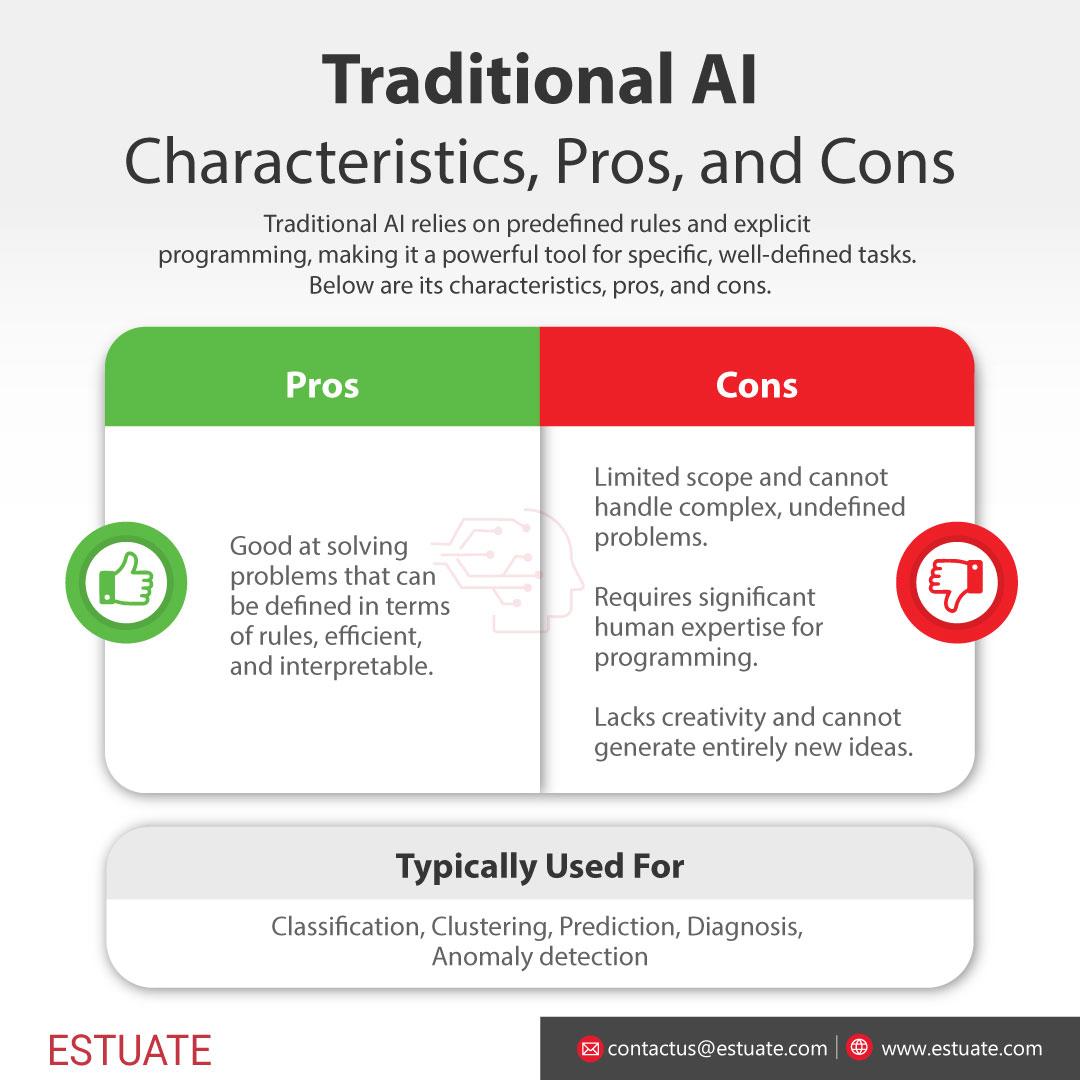
Traditional AI: Characteristics, Pros, and Cons
Generative AI: The Creative Innovator
Generative AI represents a leap towards creativity and adaptability. Unlike its traditional counterpart, Generative AI learns from vast datasets, discovering patterns and generating new outputs. This advanced AI technology can go beyond executing predefined tasks; it can innovate, create, and adapt in ways previously unimaginable. By leveraging deep learning techniques and massive amounts of data, Generative AI can produce novel content, generate realistic simulations, and provide unique solutions to complex problems.
Core Applications of Generative AI
Generative AI’s versatility allows it to be applied across various domains, enhancing productivity and innovation. Here are some key areas where Generative AI demonstrates its transformative potential:
Content Generation
Imagine a writer who never tires. Generative AI can draft contracts, create marketing copy, or even generate entire articles. It can write news reports, generate social media posts, and create fictional stories, making it a powerful tool for content creators and marketers.
Summarization and Q&A
Generative AI can condense massive reports into digestible summaries and provide accurate responses to complex questions, enhancing customer service and legal documentation processes. This capability helps businesses quickly extract valuable insights from large datasets.
Financial Scenario Generation
Acting as a strategic advisor, Generative AI models potential financial outcomes, aiding in decision-making and strategic planning. It can simulate market conditions and predict the impact of various strategies, helping businesses navigate financial uncertainties with confidence.
Pros and Cons of Generative AI
Generative AI offers remarkable benefits, but it also comes with its own set of challenges. Understanding both the advantages and drawbacks is essential for effectively integrating this technology into your business.
Pros
Creativity and Innovation: Generative AI excels at generating new ideas and concepts, making it invaluable in creative industries like design, media, and entertainment. It can design products, generate artwork, and even compose music, pushing the boundaries of creativity.
Handling Uncertainty: It excels in dynamic environments, continuously learning and adapting to new data. This adaptability allows businesses to respond quickly to changing conditions and stay competitive in fast-paced markets.
Cons
Data and Resource Intensive: Training generative models requires extensive data and computational resources, which can be costly and time-consuming. Businesses need to invest in robust infrastructure to support Generative AI initiatives.
Risk of Bias: There is potential for generating biased or misleading content if the training data is not well-curated or representative. This risk is particularly concerning in sensitive areas like healthcare and law, where biased outputs can have serious consequences.
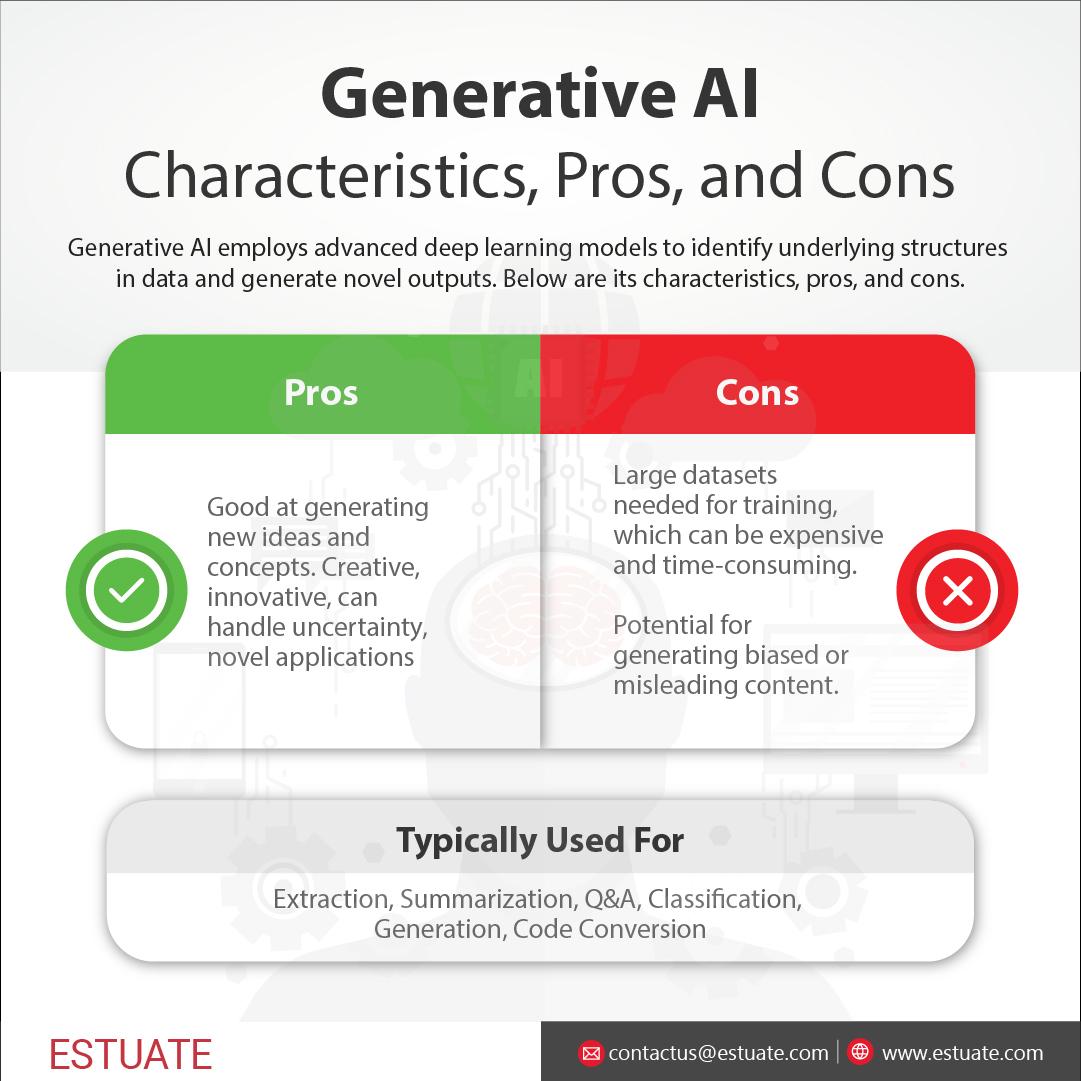
Generative AI: Characteristics, Pros, and Cons
Collaborative Use Cases of Traditional and Generative AI
Both Traditional and Generative AI play critical roles, often complementing each other to deliver comprehensive solutions across various business functions.
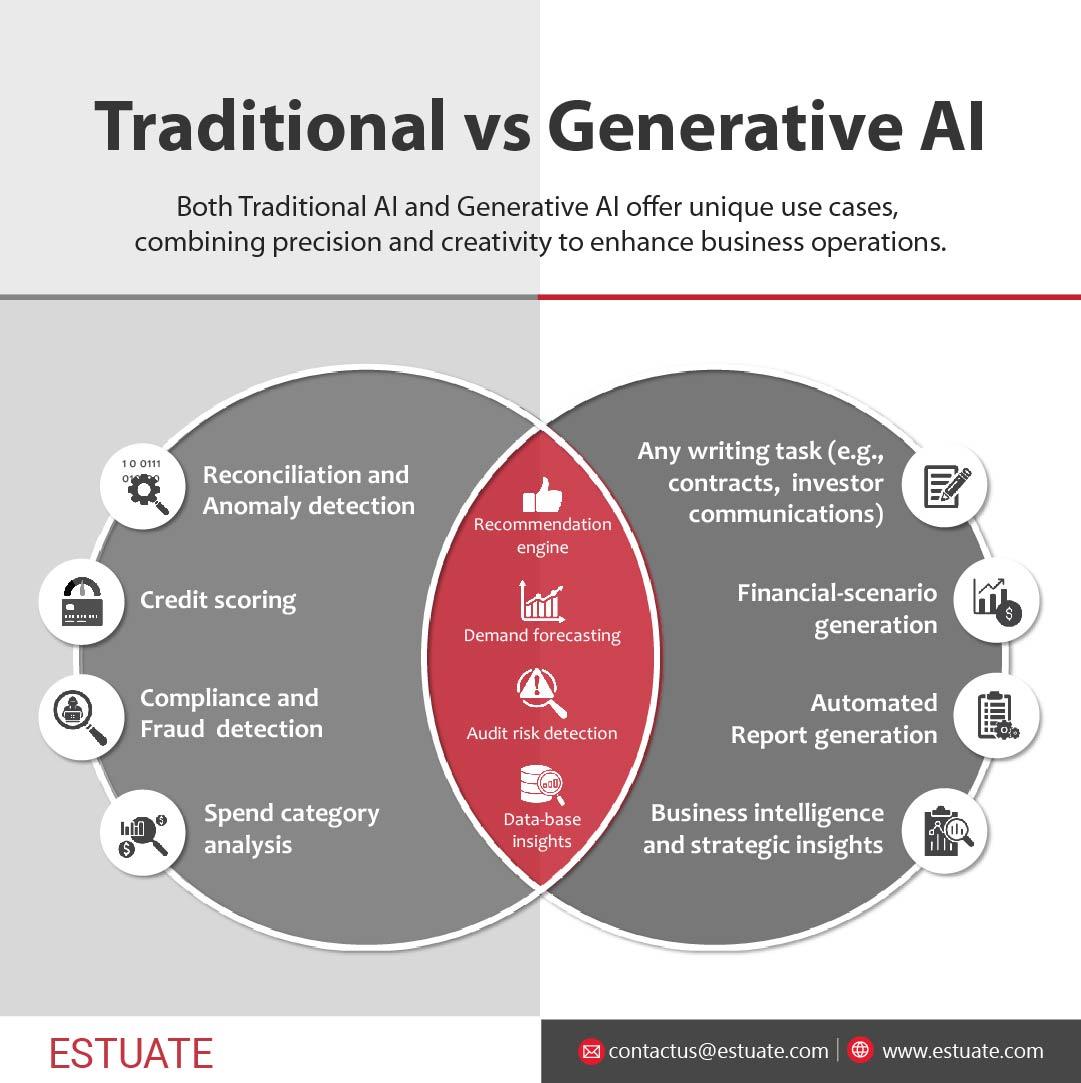
Traditional Vs Generative AI
Traditional AI Use Cases
Traditional AI has proven itself to be an invaluable tool in various business operations. Let’s explore some specific use cases where Traditional AI excels:
- Reconciliation and Anomaly Detection: Ensuring financial accuracy and preventing fraud by identifying inconsistencies in transactions.
- Credit Scoring: Assessing the creditworthiness of individuals and businesses based on historical data, helping financial institutions make informed lending decisions.
- Compliance and Fraud Detection: Monitoring transactions to ensure regulatory compliance and detecting fraudulent activities, reducing financial risks.
- Spend Category Analysis: Analyzing spending patterns to identify cost-saving opportunities and optimize budgeting, enhancing financial management.
Generative AI Use Cases
Generative AI is revolutionizing various industries by enhancing productivity and creativity. Here are some key areas where Generative AI makes a significant impact:
- Content Creation: From legal documents to creative content, enhancing productivity and creativity across various industries. Generative AI can automate routine writing tasks, allowing human workers to focus on higher-value activities.
- Financial Scenario Generation: Offering strategic insights and predictive analytics, helping businesses plan for different financial outcomes and make informed decisions.
- Automated Report Generation: Streamlining reporting processes and reducing manual errors, improving the accuracy and efficiency of business reporting.
- Business Intelligence and Strategic Insights: Providing deep, actionable insights through advanced data analysis, enabling businesses to make data-driven decisions and gain a competitive edge.
Market Potential of Generative AI
The growth trajectory of Generative AI is remarkable. It is projected to reach a market size of $36 billion by 2024 and a staggering $356 billion by 2030, with a compound annual growth rate (CAGR) of 46.47%. [Source: Generative AI – Worldwide.] This technology is expected to revolutionize industries by enabling businesses to create more personalized, innovative, and efficient solutions. Generative AI could potentially boost the global economy by 7% within the next decade, driving significant advancements in productivity and innovation.
The journey of Traditional and Generative AI illustrates the balance between efficiency and creativity, structure and innovation. By understanding and leveraging the unique strengths of both, businesses can optimize their operations, drive innovation, and stay ahead in an increasingly competitive landscape. The future of AI is not about choosing between Traditional and Generative AI, but about integrating both to harness their full potential.
For businesses ready to navigate the complexities of AI, embracing the combined strengths of Traditional and Generative AI will be key to driving continuous improvement and achieving sustainable growth.
Estuate’s Gen AI Services and Solutions
Estuate leverages Generative AI to enhance business operations, decisions, and creativity. Our solutions streamline processes, drive innovation, and unlock unprecedented possibilities for your organization.
Contact us today to embark on a transformative journey with Estuate’s GenAI solutions.