Top 5 Digital Transformation Trends in Healthcare – [Infographics]
Watch out the top five digital transformation trends in healthcare.
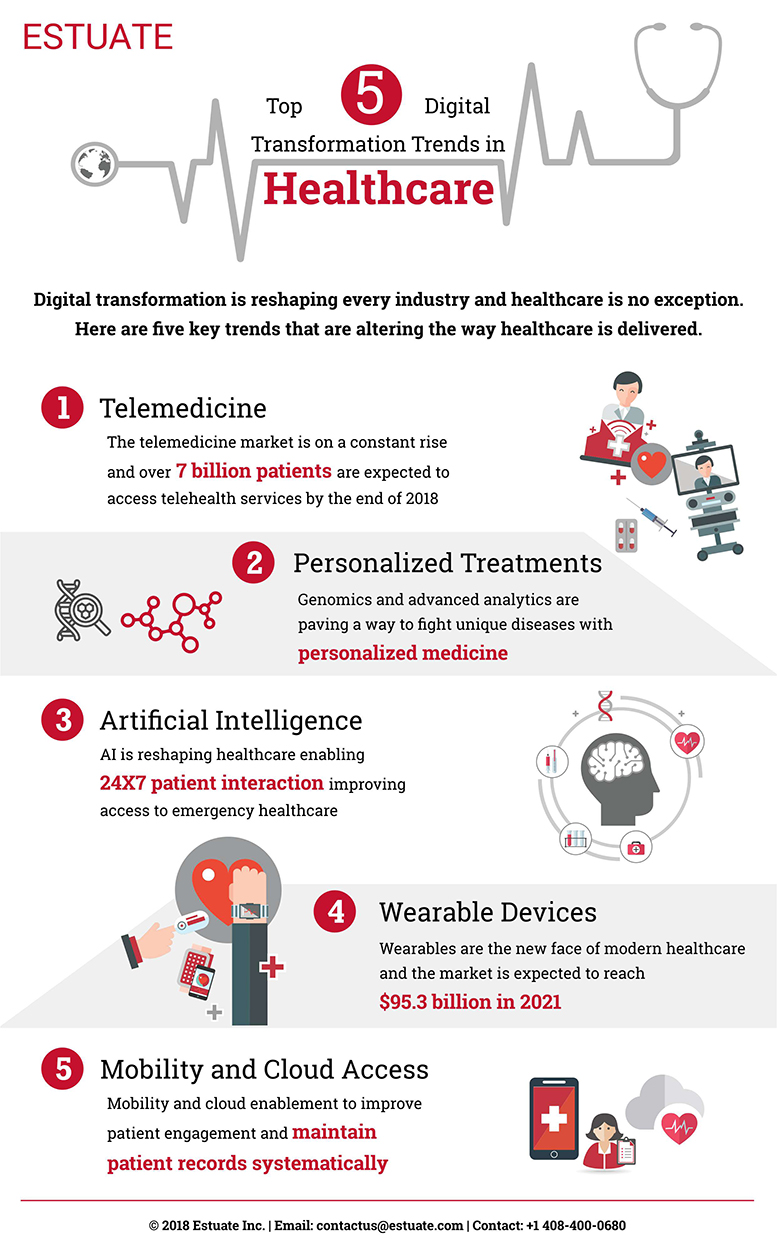

Watch out the top five digital transformation trends in healthcare.

Mobile technology is a growing business trend. Here are 5 reasons why you must consider adopting mobility in your enterprise.
Mobile phones are an integral part of our daily lives. A research conducted by British psychologists states that an average adult spends roughly 5 hours in a day using his phone.
Thanks to smartphones that come with numerous apps that make life simpler as well as entertaining. From online shopping to food delivery, web maps to mobile banking, and social media to self-healthcare apps, there’s an app for almost everything today.
As much as 269 billion mobile apps were downloaded in 2017. This rapid growth in the mobility sector is inspiring all businesses to embrace mobile technology in some form or the other. In this article, we have listed out the top 5 reasons why all businesses need to enter the world of mobility.
Greater accessibility
This is the era of hand-held devices. As of February 2017, mobile devices accounted for 49.74 percent of internet usage worldwide. Mobility is reshaping the way businesses reach out to customers. Increased mobile data usage is pushing enterprises to think ‘Mobile First’. Mobility ensures that your customers can access your products and services anytime from anywhere. It also enables you as a business to attract potential customers and engage existing customers effectively through interactive apps and mobile responsive sites.
Improved customer service
In a world where customer is the king, businesses are constantly on their toes to offer better customer service and enhance customer relations. Mobility is hugely impacting customer experience in multiple ways. It enables you to offer a personalized shopping experience based on customer purchase histories and preferences. It also facilitates faster and easier troubleshooting with 24X7 customer support. Mobility is turning out to be the foundation of excellent customer engagement.
Renewed marketing strategies
Gone are the days when marketers used to shoot email campaigns to customers only to get spammed later. Mobility is changing the role of marketing. While 65 percent of email is spam, less than 10 percent of SMS is. Traditional marketing methods are being reformed and mobile technology is being used more and more to capture markets and promote products and services. Marketers are using SMS marketing, mobile advertising and social media marketing, changing overall marketing strategies based on target markets.
Enhanced internal communication
In addition to using mobile technology to engage customers and increase sales, businesses are also developing applications and web portals to facilitate internal business communication. It is a great way to establish a strong network across the enterprise. Today, about 60% employees use apps for work-related activities. Whether it’s sharing important business information, or keeping them engaged and ensuring business goals are effectively met, enterprise mobility is now a critical component to improving internal business communications.
Better branding
Mobile technology and mobility tools expose your business to millions of potential customers, leading to improved brand awareness. The more your customers know about you, the more they’re likely to do business with you. The customer always wants more. Having a mobile responsive site, a round-the-clock support mechanism, a well-performing app, are all ways to improve your business brand and get an edge over competitors.
The concept of mobility is exciting because it is technology made portable. In a world where the customer is time-poor, businesses have to go that extra mile to offer convenience. Mobility delivers convenience, flexibility and speed, which is why customers are embracing it in all ways. Have you already entered the world of mobility to improve your business?

Have you been carrying on with your old-school systems for too long? Here’s why you need to modernize your enterprise soon.
Digital transformation is at its peak and it’s becoming more of a necessity than an initiative for all digital enterprises. As much as businesses want to transform digitally and embrace latest technology, it’s not a perfect world.
Almost all businesses carry decades-old legacy systems and disposing off the old school hardware and software can be an overwhelming process.
CIOs often face a dilemma between retaining legacy technology and bringing in latest technology to their enterprise. The question is how far can you take your legacy technology in this competitive, rapidly evolving IT space? If you too are torn between continuing with your aging technology and modernizing your enterprise, here’s why legacy systems are no good for your enterprise anymore.
Businesses running on legacy technology know how frustrating it is when it takes forever to load data in an application, hours to perform simple tasks and ages to generate reports. Regardless of how trustworthy these legacy applications are, they’re not as fast and agile as modern technologies. Moreover, they come with complex structures and manual intervention. With changing times, businesses need to speed up their operations and depending on legacy systems will only cause performance hiccups.
Maintaining legacy systems is a costly affair
CIOs believe that migrating to new technology could be an expensive deal, and hence it’s better to continue with the aging systems. Let’s break the myth here. The truth is, maintaining ancient applications involves greater costs as opposed to replacing them. On average, organizations spend from 60 to 85 percent of their IT budgets maintaining bulky hardware devices, staff training, vendor payments and support costs. So, if you’re thinking you aren’t yet prepared to spend on technology migration, you probably are already spending more than that on maintaining your legacy systems.
They’re incompatible with modern technology
In the modern business world, staying stagnant is not an option. Most mainframe applications are not compatible with new-age tools and software. This lack of flexibility restricts enterprises from being able to catch up with changing times and utilize latest market capabilities. This is a huge setback in terms of customer satisfaction and revenue management. Sticking to rigid legacy systems that fail to integrate with modern technology will put you much behind your competitors in the market.
Cybersecurity threats
Another myth associated with legacy systems is that they’re more immune to cybersecurity breaches compared to modern systems. While modern systems may be more vulnerable to security threats, it does not mean legacy systems are completely safe. Most businesses use mainframe systems for decades and they obviously carry huge sets of historical data, which could be exposed to malicious attacks at any given point in time. In fact, the older your legacy systems, the more they’re vulnerable to malware and security attacks.
Legacy systems do not support mobility
Your customers no longer depend on a desktop to access the internet. They use mobiles, smartphones and tablets to browse products, carry transactions and stay updated. As the need for mobile enablement grows for businesses, it is also imperative that the technology you use supports mobile engagement. Most legacy frameworks do not integrate with mobile technology, hindering mobile enablement for digital enterprises. If you want to catch up with your customers through mobile technology, you must consider migrating to a more modern and mobile platform.
Legacy systems were a thing back then. But today, a new wave of technology has taken over, and enterprises need to keep up with the changing times if they aspire to succeed. While technology modernization could be a very daunting decision to make, it is important to consider the pros and cons of continuing with mainframe systems. The wise option is to keep the ones that are still delivering business benefits, and replace the ones that are not.
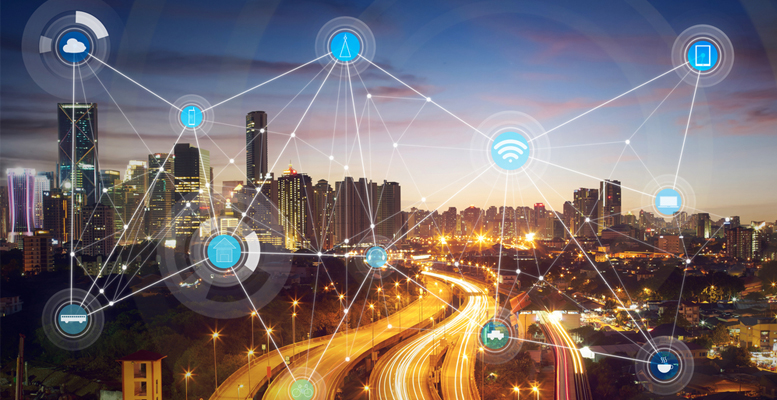
Internet of things is leading us to smarter lives. Here are 6 real-world IoT applications that are driving businesses crazy.
Technology is making devices come to life, and we are so loving the concept of Internet of Things (IoT). From hi-tech devices to smart appliances, it’s crazy how IoT is leading us to a smarter lifestyle. A Statista study reveals that in 2015, there were about 15.4 billion connected devices.
This number is expected to grow to 30.7 billion in 2020, and 75.4 billion by 2025. It wouldn’t be a surprise if in a few years we’d start calling it the Internet of Everything.
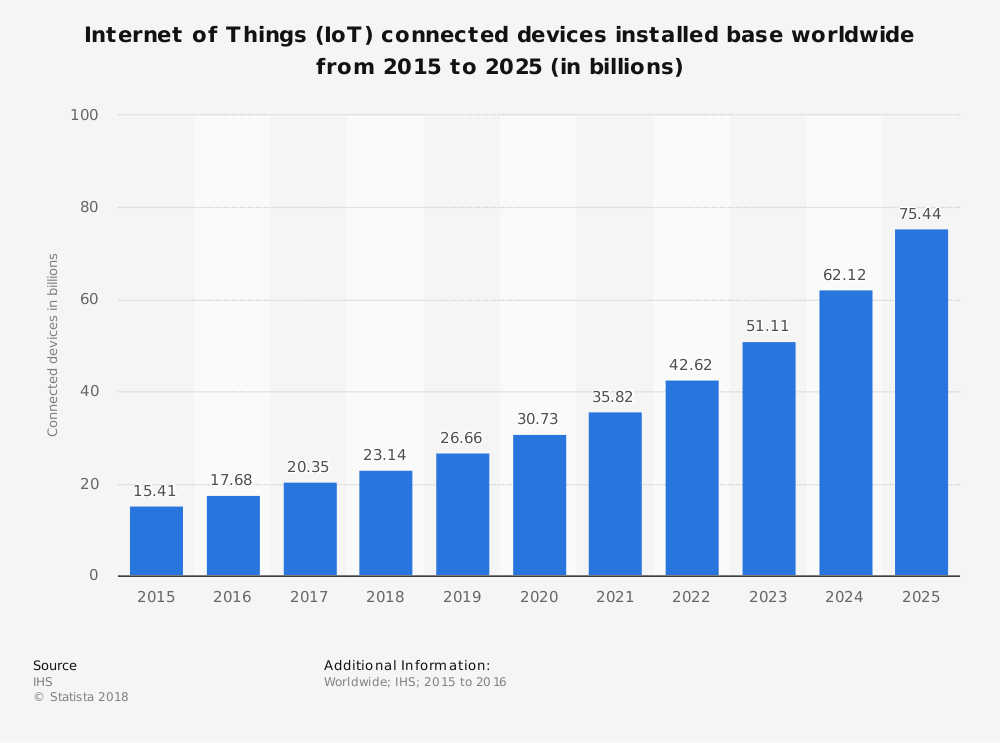
Just like any other disruptive phenomenon, the IoT market is only going to grow. It opens doors to limitless opportunities and industries are grabbing every possible chance to infuse IoT in their operations.
Check out the top 6 IoT applications that businesses are embracing with open arms.
Smart City Devices
Who doesn’t want to live in a “Smart City”? IoT is transforming cities by connecting urban infrastructures with high performing technology. Parking guidance, traffic monitors, water leakage and waste management detectors are being installed to offer a hi-tech lifestyles to citizens, and manufacturing and IT businesses are leaving no stone unturned to build devices for smart cities. The United Nations estimates that nearly 60 percent of the world’s population will live in smart cities by 2030.
Industrial IoT (IIoT)
Also known as Industrial Internet, the IIoT is rapidly becoming a widely accepted trend in the IT space. IIoT is substantially improving connectivity, efficiency, scalability, time savings, and cost savings for industrial organizations. It combines the smartest of devices, advanced analytics and Machine to Machine (M2M) communications to scale up IT operations. According to an IDC research, the estimated spending on IIoT will scale up to as much as $1.4 trillion by 2021.
eHealthcare
Technology is totally driving the healthcare industry. eHealth trends are reshaping the way healthcare is delivered and experienced globally. Wearable devices, fitness applications, connected inhalers and skin sensors are driving eHealthcare and there are immense possibilities that healthcare enterprises are constantly exploring. 73% of healthcare organizations are already using IoT for monitoring and maintenance of their operations.
Intelligent Logistics
Businesses are discovering the advantages of adopting intelligent logistics and IoT based supply management systems. IoT facilitates warehouse management, fleet management, and enables monitoring the status of assets, parcels, and people in real time throughout the value chain. Studies reveal that the logistics market will experience a 30% growth with IoT enablement.
Connected Automobiles
The consumer markets are prepared for the next big thing, connected cars and automobiles. IoT is bringing advanced features like connected vehicle sensors, fuel tracking, speed control and vehicle usage analytics for smart user experiences. Giants like BMW, Hyundai and Mahindra are making huge investments in IoT to deliver supreme travel experiences to their customers through smart cars and vehicles. About 94 million connected cars are expected to be manufactured and shipped by 2021.
Smart Retail
The retail industry has evolved with IoT technology by its side. From smart shelves to customer engagement applications, inventory management and automated packaging, retail enterprises are using IoT in all possible areas of their operations. 77 percent of retailers see that Internet of Things changes the customer experience and certainly IoT will be used even more widely by retail in the future.
Internet of Things is revolutionary and there are already more objects connected to the internet than people. The global IoT market is expected to grow from $157 billion in 2016 to $457 billion by 2020; which is no surprise at all. With time, it only gets bigger and better. IoT is soon going to be a necessity than a luxury. It’s time businesses make a move towards IoT because this is certainly going to be an IoT era.
Sources:
Statista: Internet of Things (IoT) connected devices installed base worldwide from 2015 to 2025 (in billions)
Soapbox: Where connected cars and IoT are headed in the next five years
Forbes: 2017 Roundup of Internet of Things Forecasts
Technology is changing the world for better. Watch out the 10 hottest digital transformation trends for 2018.
Technology is shaping up the way we live our lives and the way businesses operate. Over the decades, we’ve seen some breakthrough technologies making remarkable contributions in the tech world. 2017 was another year of significant technology advancements.
We saw some promising technology innovations that started out small, but are driving a digital revolution now. In this article, let’s look at the top 10 digital transformation trends that are all set to disrupt the business landscape in 2018.
1. Artificial Intelligence (AI)
Artificial Intelligence is not a newbie in the digital world. We’ve all used some sort of AI based product or service at some point in time. But today, Siri, Alexa, chatbots and virtual assistants are becoming more popular than ever before, and consumers are widely accepting AI-powered services. This has stirred a revolution in businesses worldwide to deploy AI and improve the end-user experiences.
2. Internet of Things (IoT)
The past few years have seen a gradual but increasing trend in what we call Internet of Things (IoT). IoT is the concept of integrating everyday physical objects with internet. The era of intelligent things is certainly here. Predictions reveal that in the next five years, $6 trillion will be spent on IoT solutions globally, and about 24 billion IoT devices will be installed by 2020.
3. Edge Computing
Edge computing is growing rapidly with an increase in AI and IoT. It is an innovative concept that enables smooth processing of massive data produced by IoT powered devices. This Edge-IoT partnership is proving to be revolutionary, and sooner or later, all businesses and all industries will adopt edge based computing solutions to deliver best-in-class services.
4. Cloud Adoption
Cloud based storage solutions are trending for a while now. As long as there’s big data, cloud is here to stay. Companies across the globe are adopting cloud platforms to store massive business data, improve efficiencies and attain maximum data security. Today, a movement to cloud is a strategic investment, and 73% companies are planning to move to a cloud based data center within the next two years.
5. Advanced Analytics
Big data has taken the world by storm, and most companies have already reached a stage of data saturation. With growing volumes of data, there’s a growing need for smart, advanced analytics. Analytics is what gives meaning to big data and enables informed decision making in digital enterprises. The coming years will see a massive rise in data analytics as a service and an increase in data engineering and data science careers.
6. Mobile Enablement
The world’s connected to mobile devices, and entrepreneurs are realizing the fact that an effective mobile enablement strategy can impact their businesses in a positive way. Mobility enables businesses to reach out to massive target markets and brings productivity in the way employees perform. Studies predict that IT enterprises will spend about 25% of their software budgets towards mobile application development.
7. 5G Technology
We’ve seen generations of mobile networks pass by and soon enough the breakthrough 5G technology will take over. 5G will certainly be faster than 4G and is expected to deliver greater productivity with multi-gigabits per second. Though it is still in the development phase, it is all set to bring a revolutionary ‘Gigabit Smartphone’ era.
8. Blockchain
The world’s talking about Bitcoin and cryptocurrency. While it can still be a foreign term to many, the cryptocurrency or virtual currency market is on an all-time high, and is expected to grow enormously in the near future. Blockchain is the technology designed for accounting and verification of digital currencies and is certainly going to be a growing trend in 2018.
9. Augmented Reality (AR)
Digital transformation has also impacted the gaming industry in an impressive way. “Pokemon Go” was a game that used a digital interface by placing virtual objects in the real world. And ever since, Augmented Reality has been a hot trend in the gaming world. Apart from gaming, AR is being actively used in 3D viewers, reality browsers and to deliver a wide range of experiences.
10. Remote Workspaces
Telecommuting or remote workspaces is not a new advancement. It’s been trending for a long time now, and in the coming years, there will be a widespread acceptance to remote work from both employer and employee perspectives. Advancements in technology are enabling entrepreneurs to hire talent beyond boundaries and cultures and remote workspaces are the future of digital enterprises.
Digital transformation is touching all spaces of human life and all industries and businesses in multiple ways. It has already deeply impacted manufacturing, retail, healthcare, finance and banking industries. And with time, all enterprises are realizing the growing need to digitize. How long until you adopt these trending digital transformation technologies and match up with the changing times?
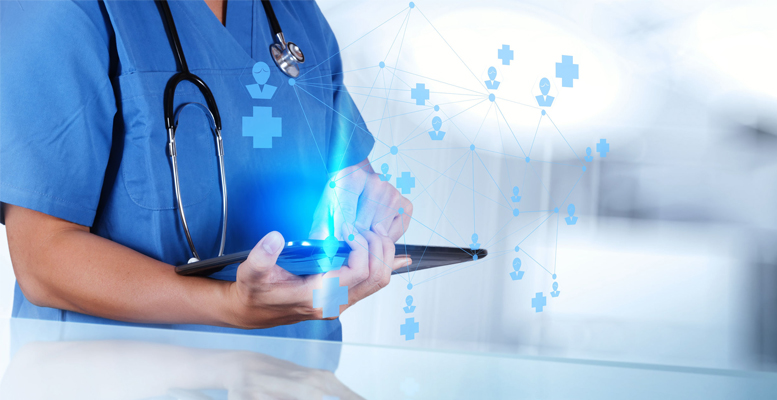
Technology is dynamically changing the way the healthcare industry works. Watch out the top five digital transformation trends in healthcare.
Technology pretty much touches all facets of mankind. But the most positive impacts of technology are evidently visible in the healthcare industry.
Over the decades, technology has seeped into every aspect of healthcare, literally transforming the industry digitally.
From patient registration to smart diagnosis and self-care tools, the healthcare sector has transformed magically; and with time, it’s only getting a notch higher.
Here are the top five trends in healthcare that are leading to a massive digital transformation.
Personalized Treatments
We’ve come a long way from providing standard, generic medicine to now offering personalized medicine. The development of personalized medical treatments lies on the fact that each individual carries unique genes and therefore our diseases may have varied characteristics. This revolution in life sciences has been possible because of genomics and advanced analytics, creating a strong way to fight rare diseases.
Telemedicine
The advancements in telecommunication have led to the breakthrough concept of telemedicine. Telemedicine is the remote delivery of healthcare services like assessment or consulting without meeting the patient in person. It’s a convenient and quick way to avail healthcare at home through telecommunication channels. By 2021, the global telemedicine market is expected to grow significantly.
Mobility and Cloud Access
The increasing use of mobile applications and cloud technology in delivering healthcare services is enhancing accessibility for patients and medical professionals. Mobile applications allow patients to access reports, monitor health and communicate with professionals at any given hour. Hospitals are moving to cloud storage solutions to store patient records, medical reports and other critical information. Mobility and cloud are reducing significant operational costs for healthcare enterprises.
Wearable devices
Wearable technology is taking over the healthcare industry in multiple ways. From fitness bands to smart watches and headbands, people are widely using wearable devices to effectively track and maintain their fitness. Also, medical professionals, especially surgeons, are adopting wearable devices like surgery goggles to help them clearly understand CT or X-Ray images. Wearables are the new face of modern healthcare and are expected to spread out even farther in the near future.
Artificial Intelligence
Healthcare enterprises are making use of artificial intelligence to catch up with the growing trends of the 21st century. AI-powered chatbots and virtual assistants enable round the clock communication with patients and ensure improved customer interaction. Additionally, artificial intelligence also plays a major role in accurate diagnosis of diseases and better clinical documentation.
We’ve reached an era where technology is the power. Sooner or later, all businesses and all industries will transform digitally. Healthcare is one of the major industries to have undergone a sea change with technology advancements. These five digital transformation trends are ruling the healthcare industry today and are completely reinventing the way healthcare is provided globally.